
The House of Orléans: A Family Tree
Why does the Orléans branch of the French royal family still fascinate British readers? Part of the answer lies just west of London, where Louis-Philippe, the last King of the French, lived out his final years in exile at Claremont House near Twickenham. Another part lies across the Channel in Normandy, in the grand halls of the Château d’Eu, where he once welcomed Queen Victoria. Between those two places stretches a family story that ties French royal history directly to Britain — and it begins with a single dukedom created in 1660.
The Origins of the House of Orléans
The House of Orléans is a cadet branch of the Bourbon dynasty, meaning it descends from a younger son of a French king rather than the direct royal line. Its founder was Philippe I, Duke of Orléans, the younger brother of Louis XIV. What began as a consolation title for a spare heir grew, over two centuries, into one of the most politically significant families in Europe.
Philippe I and the First Orléans Dukedom
When Philippe I received the Duchy of Orléans in 1660, he became the first prince of a new house. The title had existed before, but this creation gave it lasting dynastic weight. Philippe was a patron of the arts and a successful military commander at Cassel in 1677, yet his role at the court of Versailles was always shadowed by his brother’s dominance. Crucially, his marriage to Elizabeth Charlotte of the Palatinate produced a line of descendants whose claim to the French throne would one day matter enormously.
The Regency of Philippe II, Duke of Orléans
Philippe II, Duke of Orléans, nephew of Louis XIV, took power as Regent for the young Louis XV after the Sun King’s death in 1715. The Regency years (1715–1723) were a period of experimentation: the Scottish economist John Law reshaped French finance, the court moved from Versailles to Paris, and salons and theatres flourished. For our purposes, the Regency matters because it proved the Orléans line could govern, not merely hold titles — a precedent that Louis-Philippe would later invoke.
Louis-Philippe and the July Monarchy
A century after the Regency, the Orléans family stood at the centre of French politics again. Louis-Philippe’s father, Louis Philippe II, Duke of Orléans — better known as Philippe Égalité — had supported the French Revolution, voted for the execution of his cousin Louis XVI, and was himself guillotined in 1793. His British connections ran deep: he had lived in England in the 1780s and sent his sons to be educated there. That revolutionary inheritance shaped Louis-Philippe’s own careful, compromise-driven style of rule.
From Duke of Orléans to King of the French
After the July Revolution of 1830 toppled Charles X, the Bourbon monarch, Louis-Philippe was offered the crown. He accepted a revised title — King of the French, not King of France — signalling that his authority rested on a constitutional settlement rather than divine right. The change was more than symbolic: it marked the Orléans line as the liberal, bourgeois-facing alternative to the ultra-royalist branch of the family.
The July Monarchy and Its Legacy
The July Monarchy lasted from 1830 to 1848. Its eighteen years saw railway building, colonial expansion in Algeria, and a deliberate effort to improve Anglo-French relations after decades of suspicion. Louis-Philippe’s personal friendship with Queen Victoria was central to that diplomacy. The regime’s legacy is mixed — it widened the franchise only modestly and its conservative drift alienated many — but it left France with a durable parliamentary tradition and a monarchy that felt, for the first time, distinctly modern.
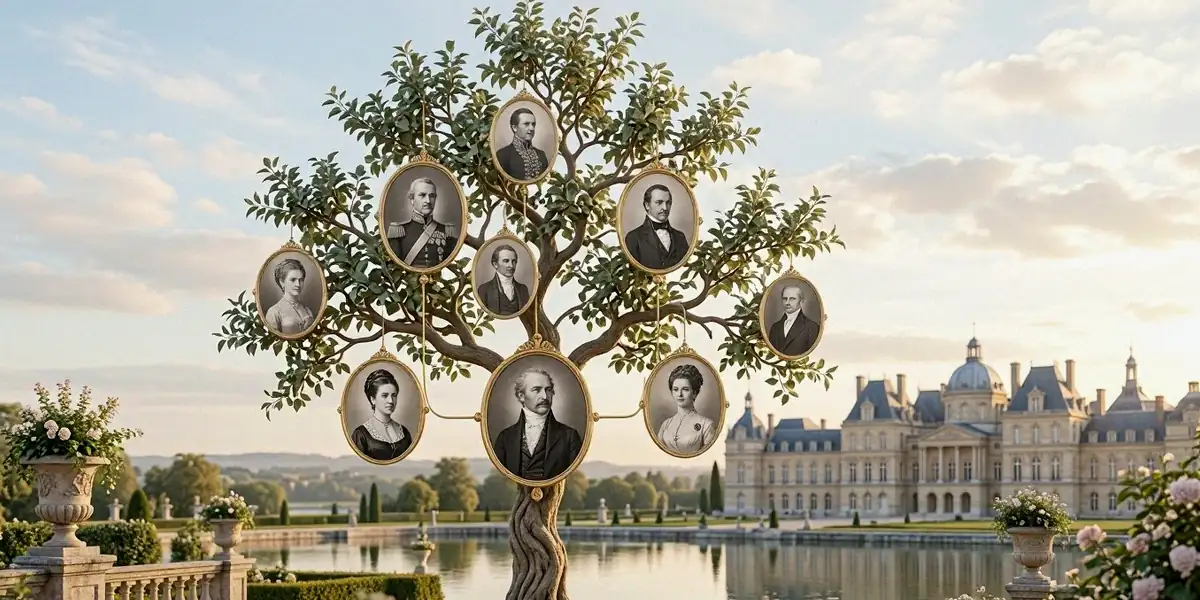
The Orléans Family Tree: Key Branches
Louis-Philippe and his siblings generated a dense network of titles, each of which became a branch of the family. Mapping them helps make sense of the names that recur in Orléanist history.
- House of Orléans: the senior line descending from Louis-Philippe himself.
- Duke of Chartres: held by Louis-Philippe’s eldest son, Ferdinand Philippe, who died in a carriage accident in 1842.
- Duke of Nemours: Louis, second son, a military figure who served in Algeria.
- Prince of Joinville: François, a naval officer who brought Napoleon’s remains back from Saint Helena.
- Duke of Aumale: Henri, who became a celebrated historian and collector.
- Duke of Montpensier: Antoine, whose marriage into the Spanish royal family caused a diplomatic crisis.
The Children of Louis-Philippe
Louis-Philippe and Queen Marie-Amélie had ten children, and their marriages were carefully arranged to strengthen the dynasty across Europe. The 1848 revolution scattered them. Ferdinand’s premature death had already complicated the succession, and the surviving princes and princesses carried the Orléans name into exile in England, Spain, and Austria.
The Orléans Pretenders After 1848
Following Louis-Philippe’s abdication in February 1848, the family fled to England, where the former king died at Claremont in 1850. His grandson, Philippe, Count of Paris, became the Orléanist claimant, and the claim passed through the family for generations. The rivalry between Orléanists and Legitimists — supporters of the senior Bourbon line — divided French royalists well into the twentieth century.
Château d’Eu: The Orléans Family Home
If the family tree is the theory, the Château d’Eu is the place where it becomes tangible. Standing in Normandy near the Channel coast, the château was rebuilt for Louis-Philippe as a summer residence and a stage for royal hospitality. For British visitors, it is the single most rewarding Orléans site to visit.
Louis-Philippe’s Restoration of the Château
The original château at Eu had medieval roots, but Louis-Philippe transformed it in the 1820s and 1830s into a comfortable neo-Renaissance residence, filling it with family portraits, historical paintings, and a celebrated collection of objets d’art. It became the family’s favourite retreat — a place of private life as well as public ceremony.
Queen Victoria’s Visit and the Entente Cordiale
In September 1843, Queen Victoria and Prince Albert stayed at the Château d’Eu as guests of Louis-Philippe. It was the first time a reigning British monarch had visited a French sovereign since Henry VIII met Francis I at the Field of Cloth of Gold in 1520. The visit was a diplomatic triumph, widely reported in both countries, and it laid groundwork for the warmer Anglo-French relations that later generations would call the Entente Cordiale. Victoria planted a tree and remembered the stay fondly; the château still displays reminders of the occasion.
The Orléans Legacy in Normandy and Beyond
The Orléans family left a visible mark on Normandy. The château at Eu anchors the region’s royal memory, while the family’s patronage touched churches, civic buildings, and local institutions. For anyone tracing French royal history on a Channel crossing, Normandy is the natural starting point.
Normandy’s Orléans Connections
Beyond Eu, the family’s presence shaped the towns of the Pays de Bray and the coast. The château’s collections, now managed as a museum, preserve the family’s furniture, paintings, and personal effects. Local tourism boards in Normandy regularly highlight the Orléans connection, and the château hosts exhibitions that draw visitors from both sides of the Channel.
The Orléans Line in the 20th Century
Later Orléanist figures kept the family’s public profile alive. The Count of Paris, Philippe d’Orléans, and his descendant the Duke of Guise maintained the claim through the twentieth century, though France’s republican settlement was never seriously threatened. The family’s modern legacy is cultural rather than political: archives, collections, and historic sites that preserve a distinctive strand of French royal history.
FAQ
Who was the founder of the House of Orléans?
The house traces its origin to Philippe I, Duke of Orléans, the younger brother of Louis XIV, who received the duchy in 1660. His descendants formed a cadet branch of the Bourbon dynasty that later produced Louis-Philippe.
Why did Louis-Philippe go into exile in England?
After the revolution of February 1848 forced him to abdicate, Louis-Philippe fled to England. He settled at Claremont House near Twickenham, where he died in 1850. The family’s earlier English ties made the country a natural refuge.
What was the July Monarchy?
The July Monarchy was Louis-Philippe’s reign as King of the French from 1830 to 1848. It followed the July Revolution that removed Charles X and ended with the 1848 revolution that restored a republic.
Why is the Château d’Eu important?
The Château d’Eu in Normandy was Louis-Philippe’s summer residence and a key Orléans family home. It is best known for hosting Queen Victoria in 1843, a landmark moment in Anglo-French relations.
Can you visit the Château d’Eu today?
Yes. The château is open to the public as a museum and is one of the principal Orléans historic sites in Normandy, with collections relating to Louis-Philippe and his family.
The Orléans family tree is far more than a list of names and titles. It is a living story that runs from Versailles to Twickenham, from the July Monarchy’s parliamentary experiments to the halls of the Château d’Eu. For British readers, that story is unusually close at hand — a short Channel crossing away, and a short train ride from London to the quiet house where a French king ended his days.