

The July Revolution of 1830 Explained for History Lovers
In just three days — 27, 28 and 29 July 1830 — Paris rose in revolt, Charles X fled to England, and a cousin of the Bourbon dynasty, Louis-Philippe, Duke of Orléans, was handed the French crown. It remains one of the most dramatic regime changes in European history, and for British history lovers it holds a special fascination: here was a revolution that borrowed language from Westminster, inspired our own radicals, and ended with a French king who had spent years in exile on these shores. This guide walks through the causes, the fighting, the man who became “King of the French”, and the legacy that still echoes through French politics.
Why France Was Ready to Explode in 1830
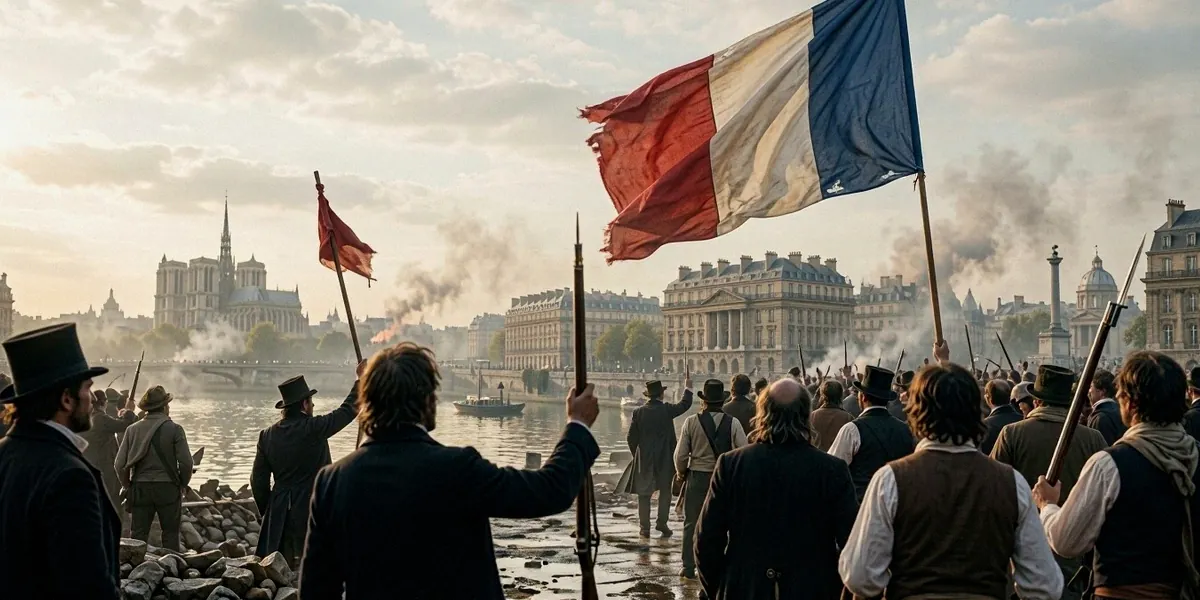
To understand the July Revolution, we have to look back fifteen years. The France that emerged from the Napoleonic Wars in 1815 was a constitutional monarchy built on an uneasy bargain, and by the late 1820s that bargain was collapsing under the weight of royal overreach, economic misery and a politically awakened middle class.
Charles X and the Ultra-Royalist Backlash
Charles X, who succeeded his brother Louis XVIII in 1824, led the ultra-royalists — the faction that wanted to roll back the French Revolution entirely. His government compensated émigrés who had lost property, strengthened the Catholic Church’s grip on education, and dissolved the National Guard, which many Parisians regarded as their own citizen militia. To liberals, Bonapartists and republicans alike, each measure looked like a step towards the old absolute monarchy.
The Charter of 1814: A Fragile Compromise
The Charter of 1814, granted by Louis XVIII, supposedly guaranteed the Revolution’s gains: equality before the law, a bicameral parliament, freedom of the press and religious toleration. Crucially, it was a royal grant rather than a popular contract, and it left the king with substantial power. French liberals — many of whom admired the British parliamentary system — argued that the Charter should be treated as a genuine constitutional settlement. Charles X treated it as a revocable concession. That disagreement was the fault line along which the regime eventually split.
Economic Hardship and the Rise of the Bourgeoisie
Bad harvests in 1828 and 1829 drove up bread prices, while industrial depression threw workers out of employment in Paris and the textile towns. At the same time, a growing bourgeoisie of lawyers, journalists, merchants and professionals was demanding a greater political voice. The electoral franchise was tiny — roughly 90,000 voters out of a population of over 30 million — and the wealthy middle class resented being shut out of a system that taxed them but did not represent them.
The Three Glorious Days: 27–29 July 1830
The trigger came on 25 July 1830, when Charles X and his ministers issued the July Ordinances. These decrees suspended freedom of the press, dissolved the newly elected Chamber of Deputies, reduced the number of deputies and restricted the franchise further to favour the landed aristocracy. It was a coup from above — and Paris answered within forty-eight hours.
The July Ordinances: Charles X’s Fatal Miscalculation
The Ordinances were published on Monday 26 July. Journalists at papers such as Le National and Le Temps refused to accept the new censorship rules and printed their defiance the next morning. The government responded with arrests and seizures. What Charles X’s ministers had not anticipated was how quickly protest would move from the printing presses to the streets. Their miscalculation was total: they assumed Paris would grumble and comply.
Barricades and Bloodshed in Paris
On 27 July, crowds gathered outside the Palais-Royal and marched on the Tuileries. Troops under Marshal Marmont fired on demonstrators, and by evening the first barricades appeared in the narrow streets of the old city. Over the following two days, students, artisans, veterans of Napoleon’s armies and members of the National Guard fought running battles with regular troops. The tricolour was hoisted over Notre-Dame. By 29 July, the Louvre and the Tuileries had fallen to the insurgents, and the royalist cause in Paris was lost. British newspapers, above all The Times, reported the events extensively, and their coverage shaped how the British public understood what was happening across the Channel.
Lafayette and the National Guard: A Republican Hero Returns
Into this vacuum stepped the Marquis de Lafayette, the veteran of the American Revolution and the French Revolution of 1789. He was persuaded to take command of the reconstituted National Guard, and his presence gave the insurrection an aura of legitimacy and restraint. Lafayette’s preference for a constitutional settlement rather than a republic was decisive: it steered the revolution away from radical republicanism and towards a change of dynasty.
Louis-Philippe: The Bourgeois King Takes the Throne
With Charles X in flight, the deputies needed a candidate. Louis-Philippe, Duke of Orléans, a descendant of the House of Orléans and a man with a reputation for liberal sympathies, was the obvious choice. He had lived in exile in England during the Revolutionary Wars, taught mathematics to schoolboys in Switzerland, and cultivated a deliberately unassuming public image. On 31 July he accepted the lieutenancy-general of the kingdom; on 9 August he was proclaimed King of the French.
From Duke of Orléans to King of the French
The change of title mattered enormously. “King of France” implied sovereignty over a territory by divine right. “King of the French” implied a crown held by contract with the people. Louis-Philippe understood the symbolism and leaned into it: he walked through Paris shaking hands, sent his sons to public schools, and dressed like a bourgeois gentleman rather than a monarch.
The Revised Charter of 1830
The Chamber revised the Charter of 1814 rather than writing a new constitution. The preamble invoking the king’s grant was removed, Catholicism ceased to be the state religion, censorship was abolished, the tricolour replaced the white flag, and the franchise was modestly widened. The revised Charter was presented to Louis-Philippe for acceptance, not granted by him — a subtle but important inversion of the political order.
A Liberal Monarchy? Promises and Contradictions
The July Monarchy promised liberal government, but its contradictions were visible from the start. The franchise remained narrow, censorship was reintroduced in various forms, and the regime’s base — the so-called pays légal of wealthy notables — excluded both the working class and the legitimist aristocracy. Republicans who had fought on the barricades felt betrayed. The regime survived eighteen years, but it never resolved the tension between its revolutionary origins and its conservative instincts.
Aftermath and Legacy: What the July Revolution Changed
The July Revolution did not just replace one king with another. It reshaped French political culture, unsettled the European order, and sent ripples across the Channel that British reformers felt immediately.
The July Monarchy: 1830–1848
Louis-Philippe’s reign saw industrial expansion, the conquest of Algeria, and the construction of the first French railways. It also saw repeated insurrections — in Lyon in 1831 and 1834, and in Paris in 1832 and 1839 — and a hardening of republican and socialist opposition. In February 1848, another Parisian revolution toppled the regime, and Louis-Philippe abdicated and fled to England, dying at Claremont in Surrey in 1850.
Impact on Britain: Reform and Revolution
British radicals and Chartists drew direct inspiration from the July Revolution. If Parisians could force a king to accept a revised charter, why should Britons not demand a wider franchise at home? The events of 1830 fed into the agitation that produced the Reform Act of 1832, and later into Chartist demands for universal male suffrage, secret ballots and annual parliaments.
Château d’Eu: A Royal Retreat in Normandy
Among the places most closely associated with Louis-Philippe is the Château d’Eu in Normandy, which he restored and made a favourite summer residence. It was there, in 1843, that he hosted Queen Victoria — the first visit by a reigning British monarch to a French sovereign since the Field of the Cloth of Gold in 1520. Today the château houses a museum devoted to the Orléans family and the history of the July Monarchy, and it remains one of the most rewarding stops on any tour of Normandy castles.
Why the July Revolution Still Matters for History Lovers
Nearly two centuries on, the July Revolution remains a case study in how constitutional arrangements can collapse when a monarch misreads the limits of his authority — and in how quickly a political crisis can become a street revolution.
Lessons for Modern Constitutional Debates
The events of 1830 raise questions that are still live today: what makes a constitution legitimate, what happens when a head of state oversteps, and how much popular consent a monarchy or any executive really needs. The July Revolution is also a reminder that the outcome of a revolution is rarely what its participants intended — the republicans who built the barricades got a king, and the king they got was gone within eighteen years.
Exploring Normandy’s Royal Connections
For British readers, the story continues across the Channel. Normandy is rich in royal and aristocratic connections: the Château d’Eu, the Château de Bizy at Vernon, and the many smaller châteaux of the Pays de Caux and the Pays d’Auge all offer windows into French royal history. These sites make an excellent itinerary for anyone wanting to combine French history with a Normandy holiday.
Key Takeaways
- The July Revolution lasted just three days, from 27 to 29 July 1830, and is also known as the Three Glorious Days.
- Charles X triggered the crisis by issuing the July Ordinances, which suspended press freedom and dissolved the Chamber of Deputies.
- Louis-Philippe, Duke of Orléans, was chosen as a compromise king and took the title “King of the French” to signal a contractual monarchy.
- The revised Charter of 1830 abolished censorship and widened the franchise modestly, but left many reformers disappointed.
- The revolution inspired British radicals and helped shape the Reform Act of 1832.
- The Château d’Eu in Normandy, a favourite residence of Louis-Philippe, hosted Queen Victoria in 1843.
FAQ
What was the July Revolution of 1830?
The July Revolution was a three-day uprising in Paris, from 27 to 29 July 1830, that overthrew King Charles X and replaced him with Louis-Philippe, Duke of Orléans. It is also known as the Three Glorious Days (Les Trois Glorieuses).
Why did Charles X issue the July Ordinances?
Charles X and his ultra-royalist ministers wanted to break the power of the liberal opposition in the Chamber of Deputies. The Ordinances of 25 July 1830 suspended press freedom, dissolved the Chamber and changed the electoral system to favour the aristocracy — a move that triggered the revolution.
Who was Louis-Philippe and why was he chosen as king?
Louis-Philippe was the Duke of Orléans, a descendant of the House of Orléans and a cousin of the Bourbon kings. He was chosen because of his liberal reputation, his revolutionary and military credentials, and his years of exile in England, which made him acceptable to reformers without alarming conservatives.
What is the Château d’Eu and why is it important?
The Château d’Eu in Normandy was a favourite residence of Louis-Philippe. In 1843 it hosted Queen Victoria, the first visit by a reigning British monarch to a French sovereign since 1520. It is now a museum dedicated to the Orléans family and the July Monarchy.
How did the July Revolution affect Britain?
British newspapers such as The Times reported the revolution extensively, shaping public opinion in favour of reform. The events inspired British radicals and Chartists, feeding into the agitation that produced the Reform Act of 1832 and later Chartist campaigns.
The July Revolution was never just a Parisian affair. It toppled a king, reshaped the French constitution, inspired reformers in Britain, and gave Normandy one of its most fascinating royal residences in the Château d’Eu. Whether you are drawn to the drama of the barricades, the politics of the House of Orléans, or the quieter pleasures of Normandy’s châteaux, this guide offers a starting point for further exploration.