
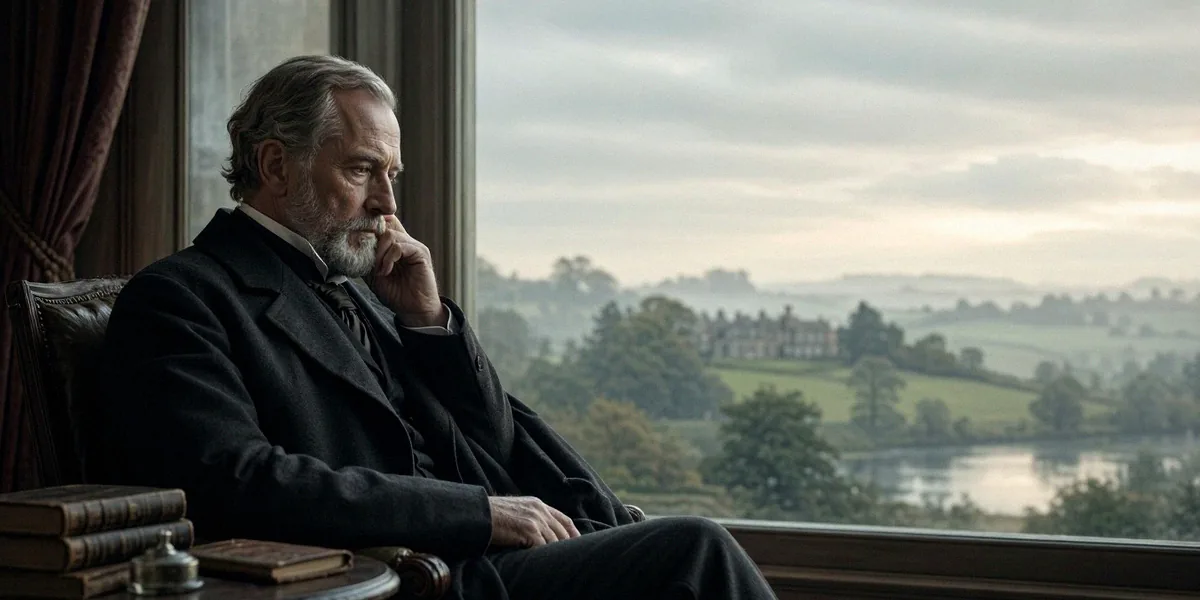
Louis-Philippe in Exile: The French King Who Died in Surrey
Here’s a fact that surprises most people we speak to: the last King of the French did not die in Paris, nor in one of the grand Normandy châteaux he loved so much. He died in bed in a quiet corner of Surrey, a few miles from Weybridge, surrounded by family and far from the country he had ruled for eighteen years. How Louis-Philippe, head of the House of Orléans, ended his days as a guest of the British establishment is one of the stranger stories in modern French history — and it begins, as so many French royal stories do, with a revolution.
From Revolution to Throne: Louis-Philippe’s Unexpected Rise
Louis-Philippe’s path to the throne was anything but conventional. He was born in 1773 into the Orléans branch of the Bourbon dynasty, a cadet line with a long history of awkward relations with the senior branch. His father, Louis Philippe II, Duke of Orléans, would vote for the execution of his own cousin, Louis XVI — a fact the family never entirely lived down.
A Bourbon with a Revolutionary Past
As a young man, Louis-Philippe embraced the ideals of 1789 with genuine enthusiasm. He joined the Jacobin Club, served in the revolutionary armies, and even fought at Valmy in 1792. When the Terror turned on his own family, he fled into exile, spending years in Switzerland, Scandinavia, and America before finally settling in England. That early spell in Britain gave him something his Bourbon cousins never had: an understanding of parliamentary government, and a genuine fondness for English country life.
The 1830 July Monarchy and the Citizen King
After Napoleon’s fall, the restored Bourbons tried to erase the revolutionary decades. Charles X’s reactionary policies finally provoked the July Revolution of 1830, and within days the Bourbon monarchy collapsed. The deputies needed a king who could reconcile revolutionary memory with monarchical order — and they chose Louis-Philippe. He took the title “King of the French,” not “King of France,” and presented himself as a citizen monarch who walked the streets with an umbrella. The House of Orléans had finally outmanoeuvred the Bourbons, but the rivalry never disappeared, and neither did the suspicion that Louis-Philippe was a usurper.
The 1848 Revolution and the Flight to England
Eighteen years later, the same revolutionary energy that had made him king destroyed him. The February Revolution of 1848 began with a banned banquet and ended with barricades across Paris. On 24 February, with the capital slipping from his control, Louis-Philippe signed his abdication in favour of his grandson and left the Tuileries for the last time.
Abdication and the Dash to the Coast
The escape was hurried and, by royal standards, humiliating. The king disguised himself in a plain coat, a round hat, and dark glasses, travelling under the name “Mr Smith” — a choice so unimaginative it has become the stuff of legend. He and Queen Marie-Amélie reached the Normandy coast near Honfleur, crossed the Channel, and landed at Newhaven on 3 March 1848. From there, the family made its way to Surrey.
- 2 March 1848: the royal party leaves Paris, travelling west towards the coast
- 3 March 1848: landing at Newhaven under the alias “Mr Smith”
- Spring 1848: temporary lodgings before settling at Claremont House
- Later 1848: the Orléans family establishes its exiled household in Surrey
Claremont House: A Royal Exile in Surrey
Claremont House, near Esher in Surrey, was already steeped in royal exile. It had been built for Clive of India, later bought for Princess Charlotte, and it belonged to the British Crown when it was offered to the Orléans family. For Louis-Philippe, Claremont became the centre of a small French court in the English countryside — close enough to London for politics, remote enough for privacy. We like to think the gentleman farmer in him appreciated the Surrey landscape after the noise of the Tuileries.
Life at Claremont: The Orléans Family in Surrey
Exile at Claremont was comfortable but never quite settled. The family lived in reduced circumstances by royal standards, though the household still ran on French lines: French spoken at table, French customs observed, French politics argued over endlessly. Louis-Philippe grew his famous side-whiskers, wrote letters, received visitors, and watched his sons and grandsons manoeuvre for position in a France that had declared them irrelevant.
Queen Victoria’s Visits and English Hospitality
Queen Victoria knew the Orléans family well. She had visited them at Eu in Normandy during happier times, and after 1848 she extended genuine hospitality to the exiled king. Victoria and Prince Albert visited Claremont, and the queen corresponded warmly with the family. British readers may find it touching that the two royal households — one reigning, one deposed — maintained such cordial relations. It was a reminder that European royalty in the nineteenth century was a small, interconnected world, and that exile was always a possible next chapter.
Keeping French Royalty Alive in Exile
The Orléans family did not simply retire. They maintained a court-in-waiting, educated their children as French princes, and kept up the rituals of the House of Orléans. Visitors came from France and from across royal Europe. The household at Claremont became a strange hybrid: an English country estate with French royal customs, a place where the July Monarchy continued in miniature long after it had ceased to exist in Paris.
The Death of Louis-Philippe at Claremont
By 1850, the former king’s health was failing. He had suffered for years from what his doctors described as general decline, and the damp English winters did him no favours. He died at Claremont House on 26 August 1850, aged 76, with his family around him.
Final Illness and Death in Surrey
Louis-Philippe’s last weeks were quiet. He received the sacraments, spoke with his wife and children, and reportedly faced the end with the calm of a man who had seen revolutions, exile, and restoration before. Whatever else could be said of him, he had lived through more of French history than almost any figure of his age. He died, as he had lived much of his life, in England.
Burial, Weybridge, and the Return to Dreux
The funeral took place at St Charles Borromeo Church in Weybridge, the Roman Catholic church that served the local community and the exiled French royal family. Louis-Philippe was buried there in 1850, but his remains did not stay in Surrey. In 1876, his body was moved to the Chapelle Royale de Dreux, the traditional burial place of the House of Orléans in Normandy. His wife Marie-Amélie was buried alongside him. So the story comes full circle: a king who died in Surrey now rests in the Normandy countryside his family had long called home.
Legacy: The Orléans Claim and Normandy Connections
Louis-Philippe’s death did not end the Orléans story — it simply moved it into a new phase. The family continued to claim the French throne, sometimes in alliance with the legitimist Bourbons, sometimes in rivalry with them, and always in the shadow of the republican France that had replaced them.
The Orléans Pretenders After 1850
After Louis-Philippe’s death, his grandson Philippe, Count of Paris, became the Orléans claimant. The family returned to France after the fall of Napoleon III in 1870, and the Count of Paris even came close to a restoration in the 1870s before the project collapsed over the question of the French flag. Later Orléans pretenders continued the claim into the twentieth century. The House of Orléans remains, to this day, one of the two main branches of the French royal family.
Château d’Eu and the Normandy Royal Story
For British readers tracing this history, the Château d’Eu is the essential stop. Louis-Philippe transformed the old château into a summer royal residence, and it was there that he hosted Queen Victoria in 1843 — the first visit by a British monarch to a French sovereign since the Field of the Cloth of Gold in 1520. The château later became a museum dedicated to the Orléans family and to the Entente Cordiale. Today it stands as the clearest physical link between Louis-Philippe, the House of Orléans, and the Normandy châteaux that draw so many UK visitors across the Channel.
FAQ
Where exactly did Louis-Philippe die?
He died at Claremont House in Surrey on 26 August 1850, in the home that had been provided for his family during their exile in England.
Was Louis-Philippe buried in England?
He was initially buried at St Charles Borromeo Church in Weybridge, Surrey. In 1876 his remains were transferred to the Chapelle Royale de Dreux in Normandy, the traditional burial place of the House of Orléans.
What is the Château d’Eu and why does it matter?
The Château d’Eu in Normandy was Louis-Philippe’s summer residence and the site of Queen Victoria’s 1843 visit. It is now a museum devoted to the Orléans family and the history of the Entente Cordiale.
How did Louis-Philippe escape France in 1848?
He abdicated on 24 February 1848 and fled Paris disguised as “Mr Smith,” travelling to the Normandy coast and crossing to Newhaven, arriving in England on 3 March 1848.
Can visitors still see places connected to Louis-Philippe in England?
Yes. Claremont House still stands in Surrey (now a private school), and St Charles Borromeo Church in Weybridge remains open to visitors interested in its French royal connections.
Louis-Philippe’s death in Surrey is more than a curious footnote. It captures the strange fate of French royalty in the nineteenth century — kings who ruled, lost everything, and rebuilt their lives in English country houses. For British readers, the trail is still traceable: from Claremont and Weybridge to the Château d’Eu in Normandy, the story of the House of Orléans runs right through our shared history.